Most people have this idea that ancient Britain must have been relatively backward and that the earliest human settlements would have been in continental Europe, places like Germany, after natural climate change caused the end of the last Ice Age. Therefore, Britain being at the extreme west at the edge of the continent would have been one of the last places to be settled.
This actually turns out to be almost the exact opposite of the case due to the beneficial effects of the Gulf Stream. During the height of the last Ice Age, much of northern Europe had been abandoned by virtually all life forms, let alone humans, due to the extreme cold and ice. Unless it can be shown that there was an incredibly fast thawing of the ice sheets, so fast that they all melted simultaneously, (and I don't think this has ever been suggested by anyone as a serious proposal), then it is obvious that Europe was resettled in the order in which it thawed out and became habitable again.
Of all of northern Europe, probably the most favoured area would have been the British Isles, jutting as it does into the warming effects of the Gulf Stream. This means that islands such as the Orkneys and Ireland would have been settled far earlier than say more central areas like Germany. This would explain why the western European seaboard is so rich in prehistoric monuments.
The Gulf Stream then as
now would have made a huge difference to Britain's climate, as much as 9c
that's the difference between a chilly spring day and a summer heat wave,
approx 60f and 78f.
see Gulf
Stream
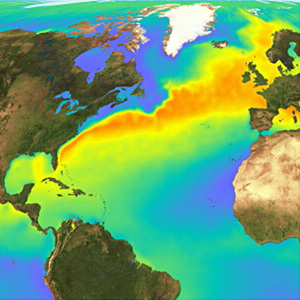
this shows how heat is distributed by the Gulf Stream directly
at the British Isles
What this means is that northern Europe was settled in this order, Ireland and the western coast of mainland Britain would have seen the first wave of settlers followed by mainland Britain and the west coast of France, Germany would almost certainly have been the last place to be settled and there may have been hundreds if not thousands of years between these major settlement dates.
home
| missing Roman road | The
real Troy discovered | pre-Roman London
| Britain's forbidden history | contact
the author

